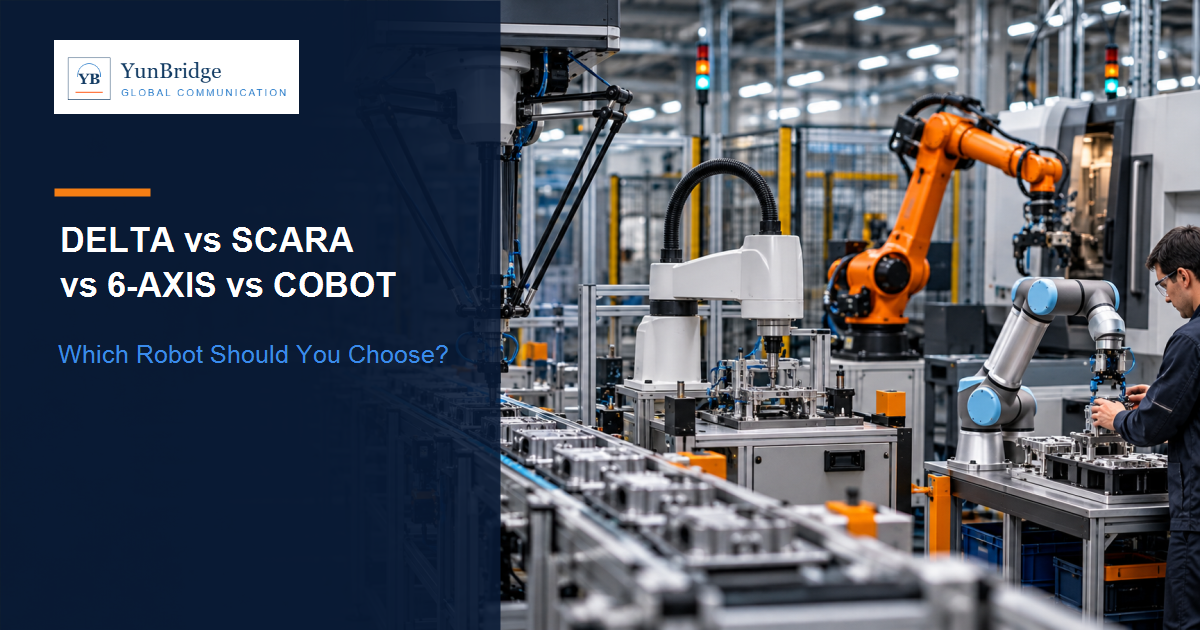
First, One Important Distinction: Cobot Is Not a Kinematic Category
Delta, SCARA and six-axis articulated robots primarily describe kinematics and mechanical architecture. A Delta is a parallel robot, SCARA is a selective-compliance horizontal articulated architecture, and a six-axis robot is a serial articulated arm with multiple rotating joints. “Cobot” or “collaborative robot” describes how the complete application is intended to operate around people and how it is designed, integrated and safeguarded.
Many cobots use six rotating joints. That means “six-axis versus cobot” can be the wrong comparison: the real question may be a traditional six-axis industrial robot versus a six-axis collaborative robot, or a collaborative solution versus a guarded high-speed cell. Universal Robots explains that collaborative describes the application, not the robot on its own. Every application still needs a risk assessment.
Read the official Universal Robots cobot overview ->
Choose the application first. The best robot is the one whose motion, payload, reach and integration requirements match the production task—not the one with the biggest headline specification.
Delta vs SCARA vs 6-Axis vs Cobot: Quick Selection Guide
| Requirement | Delta | SCARA | 6-Axis Articulated | Cobot |
|---|---|---|---|---|
| Very high-speed repetitive picking | Excellent fit | Application-dependent | Application-dependent | Usually not first choice |
| Conveyor picking | Strong candidate | Possible | Possible | Possible |
| Fast point-to-point handling | Strong candidate | Excellent fit | Strong candidate | Possible |
| Small-parts assembly or insertion | Application-dependent | Strong candidate | Strong candidate | Possible |
| Complex 3D orientation | Configuration-dependent | Usually not first choice | Strong candidate | Strong candidate depending on model |
| Machine tending | Possible | Possible | Strong candidate | Strong candidate for suitable rates |
| Frequent changeovers | Possible | Possible | Strong candidate | Strong candidate |
| Operator proximity or redeployment | Usually separated | Usually separated | Application-dependent | May be a strong candidate |
| Compact footprint | Often attractive | Often attractive | Application-dependent | Often attractive |
| Complex motion paths | Configuration-dependent | Usually not first choice | Strong candidate | Strong candidate depending on model |
Use the table to decide which architectures deserve an application test. It does not replace sizing. Actual performance depends on the selected model, payload, reach, trajectory, EOAT, vision, conveyor tracking, safety design and complete system integration.
When Should You Choose a Delta Robot?
A Delta robot is often an early architecture to evaluate when products arrive on a conveyor and the dominant requirement is fast, repetitive picking, sorting, packing or packaging. Typical buyer applications can include food handling, pouches, sachets, packaged consumer goods, top loading, tray or case loading and high-throughput product flow.
The parallel architecture can keep moving mass low and can use an overhead layout that suits an appropriate conveyor workspace. ABB positions its Delta portfolio around high-speed robotic picking, packing and packaging. That is useful context, but it does not make every Delta model the fastest option for every line. Payload, product spacing, travel distance, required orientation, vision latency, hygiene and gripper response determine the real result.
Official ABB Delta robot information ->
Delta may not be the first choice when the tool must reach around obstacles, approach from many angles, perform extensive three-dimensional orientation or work outside a practical parallel-robot envelope. Some Delta configurations add axes or different tooling, so describe the limitation as a selection trade-off rather than an absolute impossibility. Ask a supplier to demonstrate the actual product, trajectory and tool—not an unrelated showroom motion.
When Should You Choose a SCARA Robot?
SCARA is often a strong candidate for fast, repeatable point-to-point handling, insertion and assembly in a relatively compact working area. Practical applications include electronics assembly, component handling, tray-to-tray transfer, fixed-position pick and place, machine loading, inspection or test handling and screwdriving where the selected tool and process support it.
The architecture is useful when the process combines quick horizontal movement with vertical motion but does not require arbitrary tool orientation in three-dimensional space. ABB lists rapid-cycle operations, high precision, material handling, loading and unloading, picking and placing, small-part assembly and testing among SCARA applications. A SCARA is not automatically faster or more accurate than another architecture; trajectory, payload, reach and the complete cell decide that.
Official ABB SCARA robot information ->
Compared with a six-axis articulated robot, SCARA generally offers less freedom to approach from arbitrary directions, navigate around complex equipment or follow a highly varied 3D path. That reduced complexity can be an advantage: if the process does not need six degrees of freedom, extra axes may add integration and maintenance work without improving the output. The buyer should pay for the motion the process actually needs.
When Should You Choose a 6-Axis Articulated Robot?
A six-axis articulated robot becomes attractive when the tool or product must move through complex spatial poses. Six rotating joints can provide a much wider range of approach angles and orientation changes than a conventional Delta or SCARA configuration. Potential applications include machine tending, complex pick and place, part reorientation, assembly from several directions, loading around obstacles, inspection, dispensing and other process work when the selected model and tool are suitable.
OMRON describes its articulated robot range for work such as assembly, handling and machine tending, with pick and place and packaging among its application areas. Use this as architecture-level context, not as a universal specification. Reach, payload, controller, trajectory, tooling and application constraints still determine whether a particular six-axis model is appropriate.
Official OMRON 6-axis articulated robot information ->
For a simple planar pick-and-place task, six axes may provide more capability than the process needs. The project may then involve additional programming, guarding, cell space, maintenance or integration decisions. Do not assume that six-axis robots are always slower, more expensive or less accurate; those outcomes depend on the model, payload, reach, controller, motion path and complete application.
When Should You Consider a Cobot?
A cobot may deserve consideration when frequent changeovers, redeployment, operator interaction, machine tending or high-mix and lower-volume production are important. Universal Robots highlights flexible deployment, redeployment and smaller-batch production as common reasons buyers explore collaborative automation. Those benefits matter when the production problem is flexibility rather than maximum repetitive cycle rate.
A cobot is not automatically the first choice for continuous high-speed picking. Payload, reach, tool hazards, workpiece hazards, required rate, product presentation and the safety concept can change the answer. Compare the complete application and ask what collaborative operation contributes to the business case.
Universal Robots: why companies consider cobots ->
Important: A Cobot Does Not Automatically Mean “No Guarding”. Every robot application requires a risk assessment.
The assessment covers the robot, EOAT, workpiece, process, fixtures, surrounding equipment, layout and people. If hazards cannot be sufficiently reduced through the collaborative safety concept and built-in functions, additional safeguarding may still be required. Purchasing a cobot does not by itself create a collaborative application, and this article is not legal or certification advice.
Choose the Application First, Then the Robot
Before asking a supplier to recommend a robot, write down the production task and the evidence you need. The eight factors below turn a broad robot comparison into a testable application brief.
1. Payload — Including the EOAT
Payload is not just product weight. Include the gripper, vacuum tooling, sensors, brackets, cables and other tool-side components covered by the manufacturer’s payload definition. Provide product weight, centre of gravity and handling variation, then ask the selected manufacturer to confirm sizing and any required operating limits.
2. Reach and Working Envelope
Map where the robot picks, places and, if relevant, enters a machine. Include obstacles, fixtures, conveyor height, access for maintenance and whether floor, wall or overhead mounting is supported. Reach alone does not describe the usable workspace; wrist orientation, singularities, clearance and the actual motion path matter.
3. Cycle Time and Required Throughput
Define products per minute or picks per minute, travel distance, payload, orientation change, settling time, vision processing, conveyor tracking and whether one motion handles one product or several. Maximum robot speed is not stable production output. Upstream flow, camera latency, gripper response, placement and recovery can limit finished-line throughput.
4. How Much Orientation Freedom Does the Task Require?
If the product only needs a fast pick-transfer-place motion with limited reorientation, Delta or SCARA may deserve early evaluation depending on layout. If the tool must approach from several angles, rotate extensively in 3D or follow a complex path, six-axis articulated motion may become more attractive. State the actual poses instead of simply requesting “six-axis flexibility.”
5. How Is the Product Presented?
A fixed fixture, tray, indexing conveyor, continuous conveyor, random-flow conveyor and unstructured bin each create different integration requirements. Vision and conveyor tracking may matter as much as the robot itself. Describe lighting, contrast, spacing, orientation variation and what should happen when an item is not detected or falls outside the tracking window.
6. Will People Work Near the Robot?
Frequent operator interaction can make a collaborative concept relevant, but “people nearby” does not automatically make a cobot the best choice. A guarded conventional robot cell may be more appropriate for a high-speed task. Define access, loading, unloading, teaching, cleaning and maintenance activities, then require a complete application risk assessment.
7. How Often Will the Product or Process Change?
A highly optimized Delta or SCARA cell can be an excellent fit for high-volume, low-mix production. A flexible articulated or collaborative solution may become more attractive when products, tool paths or tasks change frequently and redeployment has measurable value. Compare changeover time, recipe management, tooling changes and operator training—not just the number of axes.
8. Evaluate the Complete Automation System
The arm is one component. Include vision, EOAT, conveyors, fixtures, PLC, controller, safety, upstream and downstream equipment, data communication, maintenance, spare parts and technical support. Ask who owns each interface and what documentation, backups and access are supplied. A robot recommendation is incomplete if it ignores the rest of the cell.
Which Robot Would You Evaluate First? Five Practical Examples
These are hypothetical decision illustrations, not YunBridge customer projects. The first architecture named is where a buyer might begin testing, not a final specification.
- High-speed packaged food or pouch handling on a continuous conveyor: evaluate a Delta first because throughput and repetitive conveyor picking dominate. Confirm payload, orientation, hygiene, gripper response and actual stable rate.
- Electronics component transfer and assembly between fixed stations: evaluate SCARA first when fast point-to-point motion, repeatable insertion and a compact cell fit the process.
- Machine tending where the tool must enter a machine and change orientation: evaluate a six-axis articulated robot first because approach angles, reach and clearance are central requirements.
- High-mix CNC tending or flexible lower-volume automation with frequent redeployment: evaluate a cobot or another articulated solution, subject to cycle time, payload, operator interaction and risk assessment.
- Fast repetitive production where operators only occasionally enter the cell: do not automatically choose a cobot. A guarded industrial robot solution may provide a better production fit, depending on the required rate and the agreed safety design.
A Simple Robot Selection Decision Tree
- Is extremely high-speed repetitive picking or packing the dominant requirement? If yes, evaluate Delta first.
- If no, is the task mainly fast point-to-point handling or assembly with limited orientation requirements? If yes, evaluate SCARA.
- If no, does the application require complex 3D orientation, multiple approach angles or spatial flexibility? If yes, evaluate a six-axis articulated robot.
- If collaborative operation, frequent redeployment or flexible high-mix production is a major priority, evaluate a collaborative robot solution alongside other articulated options.
This framework is only a starting point. Payload, reach, environment, EOAT, speed, safety, vision, conveyor tracking and integration requirements can change the final selection. Use an application test to validate the short list.
What Buyers Should Compare Before Choosing the Robot
| Project requirement | Questions for the supplier |
|---|---|
| Payload including EOAT | What total tool-side payload and centre of gravity does the sizing use? |
| Reach and usable workspace | Can the robot reach every pick, place, service and machine position with clearance? |
| Axes and orientation | Which poses and rotations are required, and which are optional? |
| Cycle time and throughput | What stable rate can be demonstrated with the real product, tool and line interfaces? |
| Product presentation | Is the product fixed, indexed, moving, random-flow or in a bin? |
| Vision and tracking | How are detection, calibration, encoder tracking and exceptions handled? |
| Changeover | How are recipes, tooling and format changes managed and tested? |
| Human interaction and safety | What risk assessment and safeguarding are included in the complete cell? |
| Environment and mounting | Are hygiene, dust, temperature, washdown and mounting requirements supported? |
| Integration and support | Who owns PLC, safety, documentation, backups, spare parts and remote support? |
Common Mistakes When Choosing Between Delta, SCARA, 6-Axis and Cobot
- Choosing by robot price before defining the application and complete scope.
- Comparing maximum speed instead of stable throughput under agreed conditions.
- Ignoring EOAT weight, centre of gravity and product variation.
- Assuming reach alone describes the usable working envelope.
- Assuming more axes are automatically better, or that fewer axes are always cheaper to integrate.
- Assuming a cobot means no guarding or no risk assessment.
- Ignoring vision, conveyor tracking, fixtures, controls and line interfaces.
- Choosing from a demo video rather than testing the real product and tooling.
- Ignoring documentation, software access, spare parts and support after shipment.
Choosing the Robot Architecture Is Only the First Step
After the architecture is defined, overseas buyers still need to evaluate manufacturer application experience, engineering capability, controls, tooling, vision, real cycle performance, documentation, spare parts, factory acceptance testing and after-sales support. A capable robot can still become a weak project if the supplier cannot explain responsibility for the complete automation system.
For a structured supplier review, see How to Evaluate a Pick and Place Robot Manufacturer in China: 15-Point Buyer’s Checklist. It covers application evidence, factory capability, integration, support and FAT questions.
You can also compare the broader evidence in Are Chinese Pick and Place Robots Any Good? A Practical Buyer’s Guide, which explains why robot architecture, vision, tooling, controls, testing and support should be judged together.
Once the shortlist is clear, understand what drives the cost of the complete automation project before comparing turnkey quotations.
When several suppliers need clarification, China supplier evaluation, China factory visit support and technical supplier communication can help keep the buyer’s questions and evidence organized.
Final Verdict: Delta, SCARA, 6-Axis or Cobot?
Choose based on the application rather than robot reputation. Delta is often an early candidate for very high-speed repetitive picking and packaging. SCARA is often strong for fast point-to-point handling and assembly where full 3D orientation is not required. Six-axis articulated robots are often strongest where motion flexibility, reach and complex tool orientation matter. A cobot is worth considering where collaborative operation, redeployment and production flexibility matter—but many cobots are themselves six-axis articulated robots.
The correct robot is the one that meets the required production rate, payload, reach, orientation, safety and integration requirements with acceptable lifecycle support. Ask suppliers to prove that match with the real product, tool and process before treating a model recommendation as a buying decision.